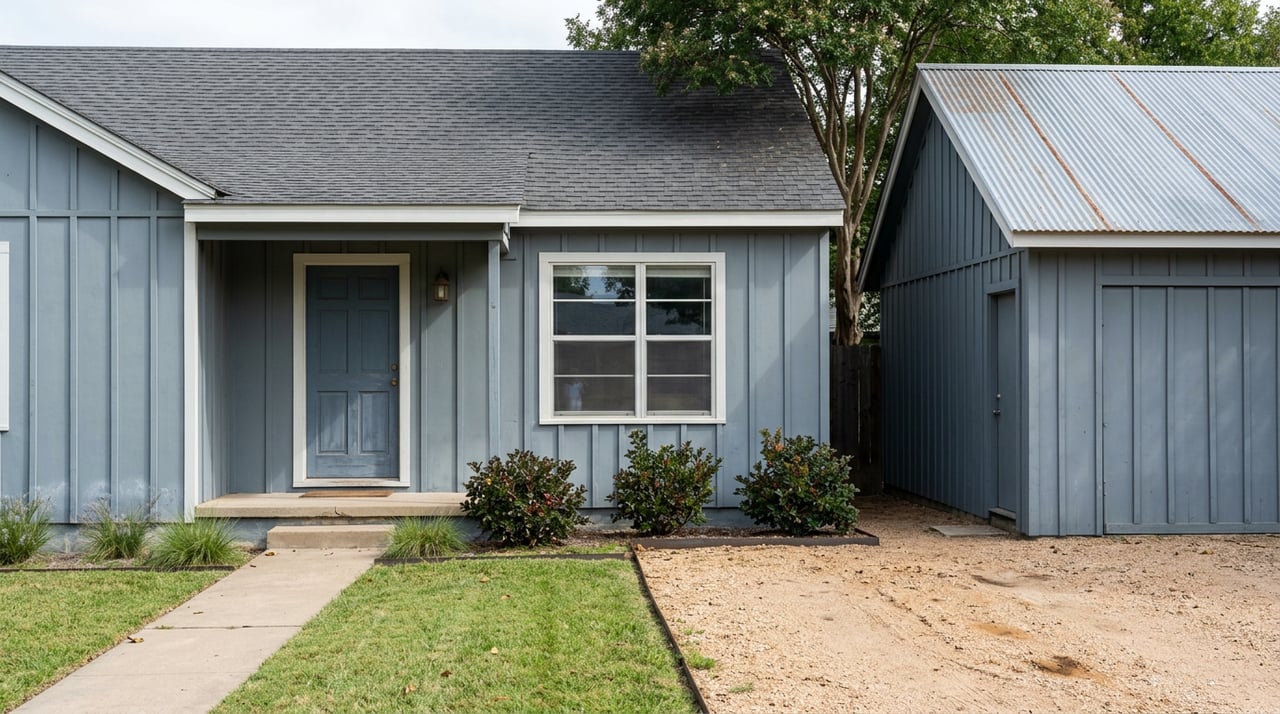
Most of Main Street in Granby still looks the way it has for a hundred years or more. The newest building on the block is trying to look that way too, even though it is not old at all. Drive past it this month and you will see a storefront dressed up like something out of an 1800s mining town, standing on a lot that had nothing but weeds on it for most of your life. Look closer and you will notice the walls are shipping containers.
That contradiction, new material wearing an old costume, is the whole story of what is happening on Granby's Main Street right now.
A Lot That Sat Empty Since the Plant Came Down
As Four States Homepage reported, the site sat vacant for more than forty years after a metal processing plant on the lot collapsed in 1985. Nothing filled the gap it left downtown until a local nonprofit called Grow Granby decided to do something about it. The project is called Mines on Main, and it is exactly what it sounds like: a strip of storefronts built for small business owners, sitting in the middle of downtown where a working building used to be.
If you have lived in Granby for a while, you already know the lot. It is the kind of empty space that stops registering after a decade or two, the gap between buildings you stop noticing because it has always been there. What is different now is that something is finally standing on it.
Shipping Containers, Dressed Like It's 1880
Grow Granby built the new structure out of eight shipping containers: seven meant for businesses, one for a shared bathroom. Containers are cheap and fast to work with compared to ground-up construction, which matters in a town without a deep well of downtown redevelopment money. But the group did not want the result to look industrial. They gave it a false front designed to read like a nineteenth-century storefront, the same kind of facade you would find on the buildings already standing around it on Main Street.
In a report by Four States Homepage, Barry Flint, who works with Grow Granby, said the group wanted it to look like part of the same downtown, not a container yard dropped into the middle of it. The report quoted him saying they put a false front on the building "to make it look like an 1800s downtown area." That choice is the reason the building reads as historic at a glance instead of temporary or improvised.
As of this month, one of the seven business units is finished and expected to get a tenant soon. Two more are still being built out. The rest are waiting on funding and volunteer hours, which is normal for a project this size in a town this small.
Old Mine Names Return to Main Street
Here is the detail that tells you the most about what Grow Granby is actually trying to do. Each container is being named after a historic mine that once operated in Granby. One of them will carry the name Morning Glory. Those mines are long closed, and the buildings connected to that era are mostly gone too, including the one that used to stand on this exact lot.
Naming a modern shipping-container storefront after a defunct mine is a strange thing to do unless you think about what the alternative would have been. There was no historic building left on this lot to restore. The plant that stood there collapsed decades ago and nothing preserved it. So instead of restoring what was lost, Grow Granby built something new and gave it the vocabulary of what came before it. The mine names are doing the work that architecture usually does: telling you what this place used to be.
Granby was founded in 1850 and still describes itself as the oldest lead mining town in the region, a claim the city and Grow Granby both lean on in how they talk about the town's identity. That history is the reason mine names, not just any names, ended up on the doors.
The Money Is Coming In Coffee Cups and Grant Checks
Projects like this do not get funded in one check. By last September, Grow Granby had put roughly $120,000 into the exterior work and still needed around another $50,000 to finish the interiors of the remaining units. That gap gets closed slowly, through donations, volunteer labor, and the kind of small local fundraising that keeps a project like this alive between headlines.
Just this month, the effort got a real boost. On August 5, 2026, Grow Granby received a $30,000 grant from Community Bank & Trust and the Federal Home Loan Bank of Des Moines, money earmarked specifically for finishing out the Mines on Main space. It is not the whole gap, but it is the kind of institutional backing that tends to unlock the next round of progress on a project that has otherwise run on volunteer hours and small donations.
Some of that fundraising happens closer to home than a bank grant. Grow Granby also runs The Foundry, a volunteer-run thrift store that funds the group's community projects, open Wednesdays from 11 a.m. to 2 p.m. and Saturdays from 8 a.m. to 5 p.m. It is a modest operation, but it is part of the same machine. A dollar from a secondhand sale on a Saturday afternoon and a dollar from a bank's community grant are both going toward the same eight containers on Main Street.
The Rest of Main Street Is Moving Too
Mines on Main is not the only thing changing hands on the block this year. This summer, city crews closed a stretch of South Main Street from Highway 60 to Neosho Street to finish repairs that heavy rain kept slowing down. If you have had to find an alternate route downtown recently, that is why.
There is also a monthly rhythm worth knowing about if you have not been to it yet. The city's Parks and Recreation Department hosts a Food Truck Frenzy at Dick Smith Park on the first Saturday of every month from spring through fall, a low-key gathering that has become one of the more reliable ways to run into neighbors on a weekend afternoon.
None of these things are large on their own. A road repair. A monthly food truck gathering. A thrift store open two days a week. But put next to Mines on Main, they start to look like the same pattern: a town with limited money finding small, steady ways to keep its downtown moving instead of waiting for one big investment to fix it all at once.
The Point
Granby did not have the option of restoring a historic building on that Main Street lot, because there was nothing left standing to restore. What Grow Granby built instead is a kind of substitute for that history: new materials, recycled from an entirely different industry, wearing a face borrowed from the century that built the town in the first place. The mine names on those containers are not decoration. They are the closest thing this project has to a cornerstone.
If you are curious about what else is changing in Granby and the towns around it, or you are thinking about what a move within Newton County might look like for your own family, Show-Me Real Estate keeps a close eye on the small developments that add up to a place's character. Schedule a free consultation with our team and we will talk through what is happening in your corner of southwest Missouri, one Main Street at a time.